
Lip Filler Revision: How to Correct Unsatisfactory Results and Restore Naturalness?
In the last decade, the most popular, most demanded and unfortunately the most abused application in the aesthetic world is undoubtedly lip augmentation. The perception of “perfect lips” imposed by social media, the popularity of techniques such as “Russian Lips” and the increase in under-the-stairs applications have introduced a new patient group to the doors of aesthetic clinics:
“Lip Victims”. Overinflated “duck lips”, “filler moustache”, asymmetrical smiles or clumped (granuloma) tissues... This picture not only spoils the aesthetic appearance of the person, but also causes regret and loss of social self-confidence every time the person looks in the mirror.
But the good news is this: Almost all mistakes made with hyaluronic acid-based fillers can be reversed. In aesthetic medicine “Lip Filler Revision” or “Lip Melting” This process, known as “reconstruction”, is much more difficult than making lips from scratch and requires much more experience and patience.
Medlook Polyclinic in Nisantasi, Istanbul As a clinic, a significant portion of the patients who apply to our clinic are those who want to correct incorrect procedures performed in other centers. We see this process not only as a “melting” process, but as the art of restoring the anatomical boundaries and naturalness of the lip to the patient. In this comprehensive guide, we will examine why fillers look bad, how the Hyaluronidase enzyme works, the importance of ultrasound technology and the “second chance” process in detail.

Part 1: Why Lip Fillers Look Bad? Anatomy of a Mistake
There are usually three main reasons behind the failure of a lip filler: Wrong Technique, Wrong Product or Wrong Anatomy Knowledge. To solve the problem, it is first necessary to diagnose it.
1. Migration (filling shift) and “filling mustache”
It is the most common problem. The border where the pink part of the lip (vermilion) and the skin meet is an anatomical barrier. If the filler is placed too close to this border, with too high pressure or in the wrong layer, it overcomes this barrier over time and leaks into the whisker area above the lip (cutaneous lip). The result is a “duck”-like appearance that protrudes forward when viewed in profile and a bulging line that creates a shadow on the lip.
2. Clumping and Nodules
If the filler is not distributed homogeneously or injected too superficially, lentil-sized hardness, lumps or asymmetrical swellings form inside the lip. Sometimes the body reacts to the filler and surrounds it and can form permanent hardness called “granuloma”.
3. Tyndall Effect (Bluish Appearance)
If the filler is injected too superficially, it creates a bluish/gray color under the skin (Tyndall effect) due to the way it reflects light. This makes the lip look dirty or bruised.
4. Excessive Volume (Overfilled Syndrome)
Too much filling to destroy the natural anatomical boundaries of the lip (tubercles) makes the lip one-piece and expressionless, like a “sausage”. The natural lip folds and Cupid's bow disappear.
Section 2: What is Hyaluronidase? The “Eraser” of Aesthetics
Our biggest weapon in the correction of faulty fillings Hyaluronidase enzyme. This enzyme is a naturally occurring protein in our body that breaks down Hyaluronic Acid (HA) molecules.
How does it work?
Hyaluronic acid fillers consist of chains held together by cross-links. When injected, hyaluronidase cuts these cross-links like scissors in seconds. The gel-like filler turns into water and is absorbed and excreted by the body's lymphatic system. The effect starts as soon as the injection is given and is complete within 24-48 hours.
Is it safe? (Allergy Test Required!)
Since hyaluronidase is an enzyme (protein), it carries a risk of allergic reaction, albeit rarely. Therefore, before starting the revision procedure at Medlook Polyclinic, we inject a very small dose of the test into the patient's arm (intradermal) and wait for 15-20 minutes. If there is no redness or itching, the procedure can be safely continued. For scientific studies on the safety and clinical use of hyaluronidase enzyme Article in the National Institutes of Health (NIH) database you can examine.
Section 3: Revision Process: Step-by-Step Correction
Lip revision is a multi-stage process that requires patience. “Let's melt it and make a new one immediately” approach is wrong and may damage the tissue.
Step 1: Mapping with Ultrasound (Seeing the Invisible)
In Medlook Polyclinic, in difficult cases (especially in lips that have been filled more than once before) Facial Ultrasound technology. We visualize the inside of the lip with ultrasound; we determine where the old filling is, its proximity to the vessels and the extent of migration. In this way, we inject the enzyme into the problematic area, not randomly, but as a pinpoint.
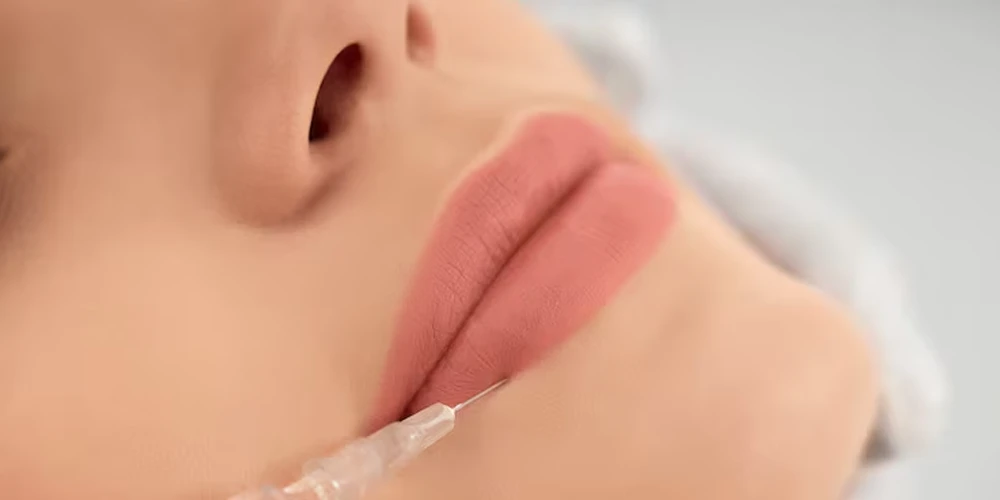
Step 2: Controlled Melting (Hyaluronidase Injection)
The enzyme is injected into the problem areas. It is normal to feel a slight burning sensation during this procedure. The physician decides whether to dissolve the entire filling or only the clumped part.
* Partial Correction: If there is only an asymmetry or lump, it can be melted locally and the shape corrected.
* Full Correction (Reset): If there is severe migration (mustache) and deformity in the lip, it is best to completely melt the lip and return it to its “original factory settings”.
Step 3: Healing and Waiting (Tissue Rest)
After the enzyme application, a temporary swelling (edema) occurs on the lips. For the filling to dissolve and the tissue to recover at least 14 days (2 weeks) should be waited. During this time, the lips may shrink, dry out and the patient may panic that “my lips are gone”. This is completely temporary.
Step 4: Refilling
Once the tissue has healed completely and the old filling has been removed, the patient is re-evaluated. We now have a clean canvas. By staying true to the natural anatomy of the lip, with the right technique (for example, with the more natural Linear Threading technique instead of Russian Lips) and the right product Lip Fillers is redone.
Section 4: Will Melting Harm My Own Lip?
This is the biggest fear of patients: “Will the enzyme dissolve my own natural hyaluronic acid?”
Answer: Yes, it melts. However, the natural HA cycle in our body is very fast (replenished in 24-48 hours). Your own tissue dissolved by the enzyme is reproduced by your body within 1-2 days. In other words, there is no permanent melting, collapse or tissue loss in your lips. Only for a few days after the procedure, your lips may appear drier and duller than normal, but this is temporary.
Section 5: Difficult Cases: Biopolymer and Permanent Fillings
Unfortunately, in some patients the dissolving process does not work. If you have had “permanent fillers” (silicone, biopolymer, etc.) of unknown origin in the past (especially 5-10 years ago), Hyaluronidase cannot dissolve them. These substances integrate with the body and harden.
The solution in this case is to surgically remove the filling. This is the domain of Plastic Surgery, not medical aesthetics. The surgical department of Medlook Polyclinic performs specialized surgical procedures for such cases.
Section 6: Second Chance After Revision: Choosing the Right Technique
You had your lips melted and waited 2 weeks. Now it's time to do it again. But the strategy must change to avoid making the same mistakes:
- Not Harder Filling, Smarter Filling: Dynamic and soft fillers that adapt to the mucosal structure of the lip should be preferred.
- Less is better, more is worse: No more than 1 ml of filler should be applied in the first session. If necessary, retouching should be done after 1 month.
- Technical Change: If your previous filling made a “mustache”, vertical techniques (fencing) or the use of cannula should be preferred to ensure that the filling is trapped in the lip frame.
Medlook Polyclinic Istanbul Nişantaşı Difference
Lip revision is more difficult than building from scratch because you are working with traumatized tissue. Istanbul Nisantasi‘located in the center of Medlook Polyclinic we manage this process as a “Lip Rehabilitation”.
- Psychological Support: We understand the patient's trauma and build trust by taking our time and explaining each step.
- Technological Superiority: We do not perform “blind” dissolution by detecting the filling with ultrasound guidance.
- Transparency: We share the dose and brand of Hyaluronidase used with the patient.
Frequently Asked Questions (FAQ)
Does the melting process hurt a lot?
When the hyaluronidase enzyme is injected, it causes a slight burning sensation (like a bee sting). This burning lasts only 10-15 seconds. In our clinic, strong anesthetic creams are applied before the procedure and comfort is increased by mixing lidocaine (narcotic) into the enzyme.
Will my lips sag after melting?
No, the lip tissue is quite elastic. When the filler is removed, the skin quickly recovers (retracts). However, in elderly patients who have used very high volume fillers (3-4 ml) for years, there may be a slight loosening due to decreased skin elasticity; this is supported with new fillers.
Can filling be done immediately after melting?
Absolutely not. The enzyme can remain active in the tissue for 24-48 hours. If you make a new filling immediately, the enzyme will dissolve that new filling. In addition, the filling applied to edematous tissue will be asymmetrical. The healthiest period is 2 weeks.
What causes migration?
It usually occurs as a result of too much filler at once (the tissue pushes the filler out because there is no space left), incorrect technique (injection into the muscle) or the patient constantly moving the filler with his/her tongue/lip (massage effect).
Conclusion A Journey Back to Nature
A poorly made lip filler is not your fate. Getting rid of artificial or problematic fillers that do not suit your face is the first step in restoring the natural beauty and expression of your face. This process may require some patience, but the result will be worth it to feel “like yourself”. Medlook Polyclinic's expert physician staff in Nişantaşı, Istanbul Contact us now to meet with us, analyze the condition of your existing filling with ultrasound and create your revision plan. Free your smile with a free pre-consultation appointment.










 Turkish
  English
  German
  French
  Italian