

How Is Hair Transplant Performed in Women, and Is It Suitable?
 Dr. Handan YavuzUpdated 6 min read
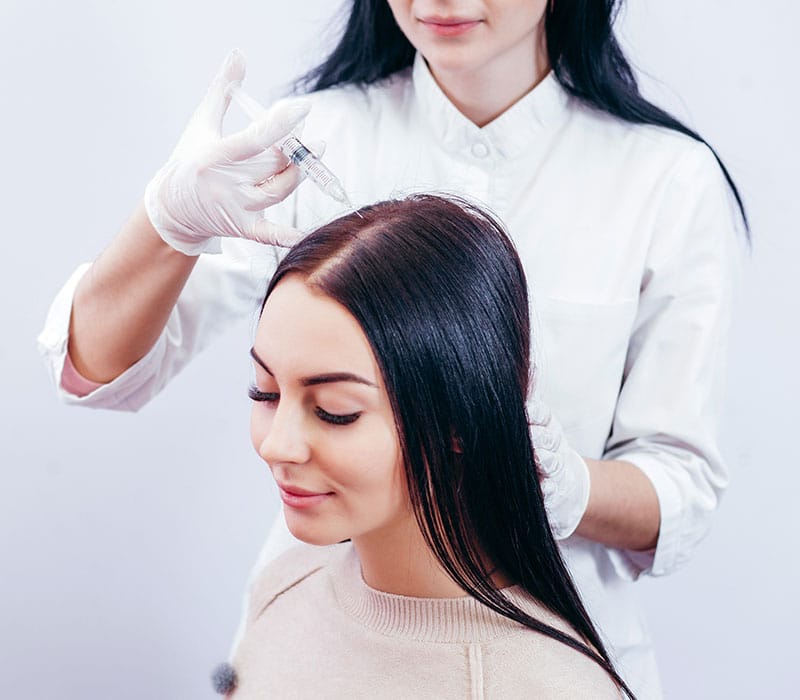
Hair loss is not a problem specific to men; it affects women in a similar way. Hair transplant in women, can be a permanent solution that thickens thinning areas in suitable candidates. However, the pattern and causes of hair loss are different in women. That is why the assessment and planning also differ from those in men.
In this article, we discuss the causes of hair loss in women, who is suitable for a transplant and the differences in the process. The aim is to clarify the right candidate and realistic expectations. This way, you can understand whether a transplant is suitable for you. We explain each heading in plain language.
Highlights
- Hair loss in women usually preserves the hairline and thins at the crown.
- Before a transplant, hormonal and nutrition-related causes are investigated.
- Good results are obtained in women with suitable donor capacity.
- Unshaven options that preserve the existing hair can be considered.
- With the right candidate selection, satisfaction is reported at close to 90% in studies.
Who Is Hair Transplant Suitable for in Women?
Hair transplant in women is suitable for those who have permanent thinning and sufficient donor capacity. Thinning concentrated in a specific area is the most favorable picture for a transplant. Planning can also be done for women with a receded hairline. Suitability becomes clear once the cause of the hair loss has been investigated.
In diffuse hair loss of unclear cause, medical treatment is tried first. In hormonal or nutrition-related hair loss, these causes are addressed first. A transplant comes into question only after the hair loss has stabilized. The right timing is important for the permanence of the result.
What Causes Female Pattern Hair Loss?
Female pattern hair loss appears as a diffuse thinning of the hair at the crown. Genetic predisposition is the most common cause. Hormonal changes, stress and nutritional deficiencies can also be triggers. Identifying the cause correctly determines the treatment approach.
This type of hair loss does not create complete baldness as in men. Usually the hair density decreases but the line is preserved. That is why the assessment requires attention to fine details. A correct diagnosis also prevents an unnecessary procedure.
- Genetic predisposition and family tendency,
- Hormonal changes and imbalances,
- Iron and vitamin deficiencies,
- Intense and ongoing stress,
- Certain medications and thyroid problems.
What Does Crown Thinning Look Like?
Crown thinning is noticed by a widening parting and a more visible scalp. It becomes more visible in the light or when the hair is pulled back. This picture is the most typical sign of female pattern hair loss. Noticing it early widens the treatment options.
Because the thinning progresses slowly, it can be overlooked at the start. Photographic follow-up reveals the change objectively. That is why regular observation is recommended. Early assessment allows intervention at the right time.
- A parting that gradually widens,
- The scalp showing more in the light,
- Noticing that the volume has decreased when the hair is pulled back,
- A decrease in density at the crown,
- The frontal hairline mostly being preserved.
What Role Do Hormonal Causes Play?
Hormonal causes are among the important triggers of hair loss in women. Processes such as pregnancy, the postpartum period and menopause affect the hair cycle. Thyroid disorders are also a common cause. In these cases, the underlying problem must be addressed first.
Hormone-related hair loss can often be temporary. That is why the decision for a transplant should not be rushed. For the relevant framework, you can refer to publications on hair transplant in women . A correct diagnosis prevents an unnecessary procedure.
- The effects of pregnancy and the postpartum period,
- The hormonal balance that changes with menopause,
- Disorders related to the thyroid gland,
- Conditions such as polycystic ovary syndrome,
- The effects of some hormone-containing medications.
How Is the Hairline Planned in Women?
In women, the hairline is planned with a different aesthetic approach than in men. The aim is to bring the receded line forward in a natural way. A round and soft line suits the female face better. This design is made individually according to the facial proportions.
Preserving the existing hair is the priority of the planning. The transplant focuses on thickening without damaging the existing density. A natural line keeps the result from being noticed. A good design continues to look natural for many years.
Which Tests Are Done Before a Transplant?
In women, the assessment before a transplant is more comprehensive than in men. Blood tests are requested to understand the cause of the hair loss. Iron, vitamin and hormone levels are examined. These tests reveal the real cause.
If there is an underlying problem, it is treated first. In this way, the result obtained from the transplant is permanent. The assessment also shows whether a transplant is necessary at all. A proper examination is the foundation of a sound decision.
- Measuring iron and ferritin levels,
- Performing thyroid function tests,
- Investigating vitamin and mineral deficiencies,
- Evaluating the hormone profile,
- A detailed examination of the scalp.
Is the Procedure Different in Women?
The transplant technique is fundamentally the same in women and men. The difference emerges in the planning and design approach. In women, the priority of preserving the existing hair is more pronounced. That is why the transplant is carefully performed between the existing density.
The donor area is again taken from the nape and above the ears. Channel opening and placement are performed with the same care. The aim is a natural and unnoticeable thickening. An experienced team works without damaging the existing hair.
- The technique is fundamentally the same as in men,
- The difference emerges in the planning and line design,
- The priority of preserving the existing hair is more pronounced,
- The transplant is performed between the existing density,
- The donor area is again taken from the nape and above the ears.
Is an Unshaven Option Possible?
Unshaven transplant is a frequently preferred option in women. In this method, only a hidden area is shortened in the donor region. In this way, the long hair is preserved and the procedure is concealed more easily. Suitability depends on the location and extent of the thinning.
The unshaven method may not be applicable in every case. In large areas, partial shaving may be required for full control. Which option is suitable is determined at the examination. The right choice matters for both comfort and result.
What Are the Recovery and Result Timeline Like?
In the first days there is redness and scabbing, which subside within a week. From the second month, temporary shedding may be seen. New hair starts to appear after the fourth month. A noticeable result settles in the eighth month, and the full appearance takes a year.
In women, the existing hair conceals the result more quickly. That is why the recovery period is often more comfortable. Patient follow-up gives the most realistic assessment. The result is a natural thickening blended with your own hair.
Although long hair conceals the transplant area, you need to be gentle in the first days. Leaving the hair loose instead of pulling it back tightly protects the grafts’ hold on the roots. Combing and drying are done gently for a few weeks. This simple care contributes to a natural-looking result.
Contact Us
Contact Us Now for Free Consultation and Appointment!
Who Is Not Suitable for a Hair Transplant Among Women?
Diffuse hair loss of unclear cause is not a suitable picture for a transplant. If there is an active hormonal imbalance, it is addressed first. If the donor capacity is insufficient, the expected result from the transplant cannot be achieved. These situations are determined through a detailed assessment.
Unrealistic expectations are also part of candidate selection. For some women, medical treatment may be more suitable. Proper guidance prevents an unnecessary procedure. Suitability is always assessed individually.
- Diffuse hair loss of unclear cause,
- Hormonal problems that are not under control,
- Insufficient donor capacity,
- Active scalp disease,
- Unrealistic expectations.
Comparison of Hair Loss and Transplant in Women
The table below summarizes the approach to hair loss and transplant in women.
| Topic | Situation in Women | Approach |
|---|---|---|
| Pattern of hair loss | Thinning at the crown | Hairline is preserved |
| Why? | Genetic, hormonal | Investigated first |
| Hairline design | Soft, rounded | Planned to suit the face |
| Shaving | Mostly hidden | No-shave option |
| Conclusion | Natural thickening | Blends with existing hair |
For an overview, you can read our How is Hair Transplantation Done? our guide and, for large areas, 5000-graft hair transplant article; for other topics, you can browse our hair transplant category.
Personalized assessment for hair loss and hair transplantation in women is carried out at Medlook Private Clinic. For any questions, please you can contact.
Author: Dr. Handan Yavuz, Medical Aesthetics Specialist. This content has been prepared for people who are curious about hair transplantation in women.
Frequently Asked Questions (FAQ)
Is hair transplant permanent in women?
The transplanted roots are permanent because they are taken from an area resistant to hair loss. However, the loss of existing hair requires separate follow-up. The permanent result is better preserved if the cause of the hair loss is under control.
Do I have to shave my hair?
In most cases, an unshaven transplant is possible and long hair is preserved. Only a hidden area is shortened in the donor region. In large areas, partial shaving may be required; the decision is made at the examination.
Is every woman suitable for a transplant?
No. In diffuse hair loss of unclear cause, medical treatment is tried first. Suitable donor capacity and a certain thinning pattern are required. Suitability is determined through tests and an examination.
Is a transplant performed in hormonal hair loss?
The hormonal cause is addressed first, because this type of hair loss can be temporary. A transplant performed without balancing the cause may not give the desired result. The right timing is important for permanence.
Does the result look natural?
With proper planning, the result is quite natural. The transplant is performed between the existing hairs without damaging them. A soft hairline design keeps the result from being noticed.
How long does recovery take in women?
Within the first week, the scabs fall off and the skin returns to normal. New hair appears after the fourth month, and the result settles in a year. Existing hair mostly conceals this process more easily.
Can’t find your question here?Send us what you would like to know and our team will get back to you.
WhatsAppYou May Also Like
NoMor or Light Filler? 5 Differences Under the Eyes
NoMor or light filler for the under-eye area? Compare the purpose and effect of both methods, and which type of dark circle each suits, from an expert perspective.
PRP Prices 2026: What Do They Depend On?
What do PRP prices depend on, and which factors determine the cost? We explain, from an expert's perspective, how the number of sessions, kit type and treatment area affect the 2026 price.
How Many Sessions of Hair PRP? Procedure and Aftercare 2026
What is hair PRP, how does it work against hair loss, and who is it for? We cover the use of plasma prepared from a person's own blood for hair.
 Turkish
 English
 German
 French
 Italian
 Russian
 Romanian